

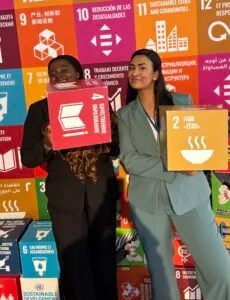
Representatives of the AFS Youth Assembly attended the United Nations World Programme of Action for Youth (WPAY30). This event was designed to provide a policy framework and practical guidelines to improve the situation of young people around the world, with a focus on areas such as education, employment, and health. This was a historic occasion, as the event was convened on the 30th anniversary of the World Programme of Action for Youth — the first action plan on policies and programmes for youth was adopted, and during the 80th UN General Assembly.
Our Impact Coordinator for Africa, Joyceline Kwarko, represented the AFS Youth Assembly at this important gathering. Read her reflections below to find out more.
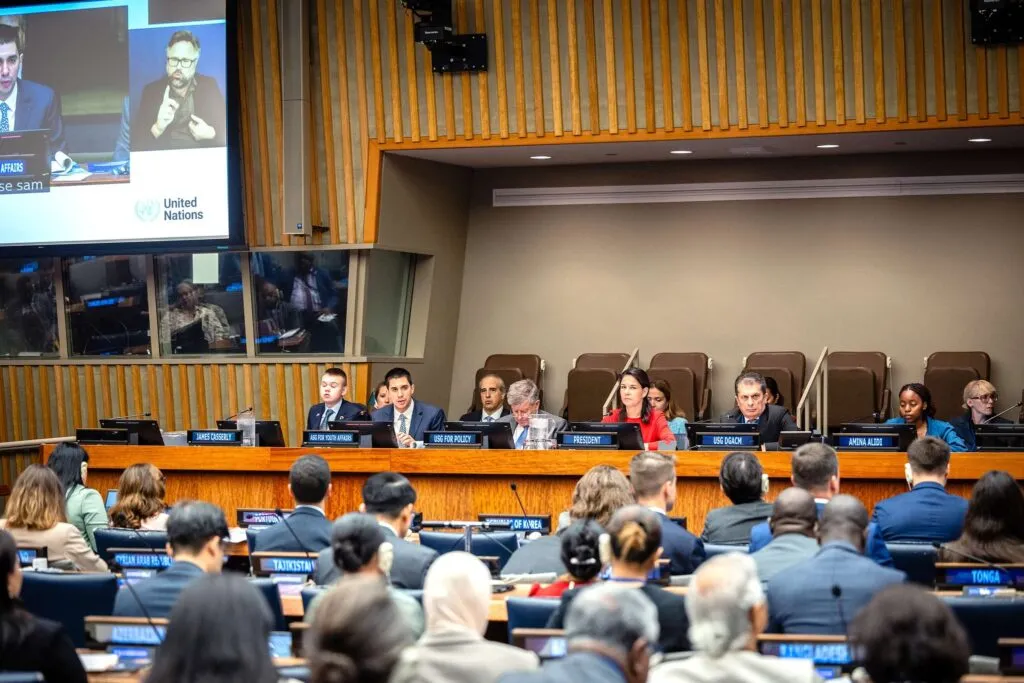
Attending the World Programme of Action for Youth (WPAY) 30th Anniversary event at the United Nations Headquarters was both inspiring and thought-provoking. The event, themed “Accelerating Global Progress Through Intergenerational Collaboration,” brought together a diverse group of youth leaders, policymakers, and civil society representatives to reflect on the progress made since the WPAY was first adopted and to chart the way forward. What made it even more remarkable was that, for the first time, an event during UNGA week in NYC placed youth at the center. With heads of state, ministers, and global leaders all under one roof, it was truly powerful to witness young voices not only represented, but heard, speaking up for youth around the world.
Notable speakers at the event included Felipe Paulier, Assistant Secretary-General for Youth Affairs, Hoaliang Xu, Acting Administrator of UNDP, Diene Keita, Executive Director of UNFPA, and Melissa Flemin, UN Under-Secretary-General for Global Communications. Hon. Ibrahim Sannoh, Minister of Youth Affairs of Sierra Leone, also delivered impactful remarks on national efforts to place youth at the center of policymaking. Key institutional voices included representatives from Teach for All, the Global Students Forum, the Inter-Parliamentary Union (IPU), UNDP, and UNFPA, each contributing critical discussions around youth participation.
These discussions highlighted both achievements and ongoing challenges. Several countries shared encouraging examples. Sierra Leone especially presented its Youth Incubator Programme, which combines funding and education to support climate-focused initiatives. Iran described skills training that responds to local employment demands. These efforts show that when youth strategies are intentional and inclusive, meaningful change is possible.
Still, many barriers persist. From limited access to resources and quality education, to underrepresentation in decision-making spaces, young people across regions continue to face structural hurdles. A recurring message throughout the day was the need to go beyond symbolic inclusion. Real advancement will only happen when youth are genuinely empowered to lead and influence outcomes.
One of the most impactful takeaways from the event was the emphasis on sustainable investment in youth. Speakers repeatedly stressed that the issue is not only about increasing funding but also about ensuring that financial and educational support is equitably distributed and easy to access. Accessibility, transparency, and strategic allocation are all essential to making youth initiatives more effective.
The importance of working across generations came up frequently. Many called for mentorship opportunities, co-creation between younger and older leaders, and the intentional creation of shared spaces where diverse perspectives can come together to solve problems. Initiatives such as Canada’s youth engagement model and Colombia’s efforts to place young agricultural leaders in decision-making roles reflect the potential of these partnerships.
The call to “leave no one behind” was more than a phrase. It served as a powerful reminder of our collective duty to reach young people who are often marginalized. Whether in conflict zones, remote areas, or underserved communities, youth everywhere must be given equal opportunities to contribute to their societies.
What stood out most was the unity in the voices of youth from around the world. From Madagascar to Gaza, and from Bangladesh to Ireland, young delegates and national representatives alike reinforced the urgent need for action. There was a shared sense that achieving the goals of the WPAY, the 2030 Agenda, and other global frameworks depends on how intentionally we involve young people today.
This event made one thing very clear. Young people are not simply part of future plans. We are active contributors to solutions happening right now. Ensuring our meaningful participation at all levels is critical to building a more inclusive, just, and sustainable world for generations to come.
About the Author